
T: +86-13955534080
E: salesb@masfy.com
E: salesb@masfy.com
West ChaoShan Road, Economic and Technical Development Zone, Maanshan,Anhui,China
Views: 0 Author: Site Editor Publish Time: 2026-10-23 Origin: Site


A shattered bearing on a job site does not just halt a single machine. It drains thousands of dollars in unplanned downtime, emergency field labor, and missed project milestones. Heavy machinery relies entirely on the structural integrity of its rotational joints to function safely. If the bearing fails, the machine becomes a massive safety hazard.
Choosing the wrong slewing ring for construction often leads directly to catastrophic mechanical failures. This puts both operators and project timelines at severe risk. In this technical guide, we walk through the precise engineering steps required to select the correct rotational component. From analyzing complex load profiles to evaluating advanced metallurgy and environmental sealing, you will gain the field-tested insights needed to make bulletproof procurement decisions.
Load Profiling is Crucial: Understanding the exact mathematical difference between dynamic operational loads and static holding loads dictates your fundamental bearing architecture.
Design Architecture Matters: Single-row ball bearings work fine for light tasks. However, triple-row roller slewing rings remain the uncompromising standard for heavy-duty earthmoving.
Material Over Dimensions: A reliable rotational joint requires precise high-alloy steel grades and specialized induction hardening. Physical size matching alone is a dangerous gamble.
Application Specificity: Different equipment scales demand highly specific gear configurations and advanced environmental sealing solutions.
To make intelligent engineering decisions, you must first understand the mechanical foundation of these specialized components. Heavy-duty construction equipment operates under brutal conditions. These environments push mechanical limits to the brink and require rotational solutions engineered specifically for extreme, multi-directional stress.
A slewing ring is a large-scale rotational bearing designed to facilitate continuous or oscillating movement between two distinct structural sections of a machine. Standard industrial bearings primarily handle either radial or axial forces in isolation. In contrast, these robust components are engineered to support complex, simultaneous loads.
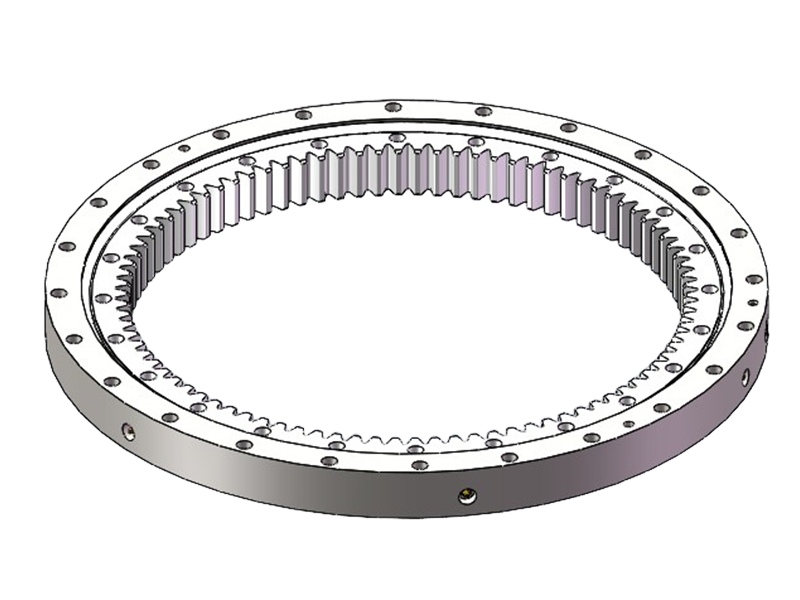
The internal anatomy consists of a forged inner ring and an outer ring. One of these rings typically incorporates precision-machined gear teeth to connect with a hydraulic drive pinion. Nestled between these rings lie the rolling elements, which can be hardened steel balls or cylindrical rollers. Precision-engineered cages or spacers prevent these elements from grinding against one another under intense pressure. Finally, heavy-duty elastomer seals bridge the gaps between the rings. They retain vital lubrication while blocking external contaminants like silica dust and abrasive mud.
Engineers often ask why standard industrial bearings cannot simply be scaled up for construction use. The answer lies entirely in the physics of overturning moments. Standard bearings run efficiently in controlled factory settings with predictable loads. Construction machinery operates in a chaotic physical landscape. Picture a 50-ton excavator tearing through compacted clay, or a crawler crane lifting a massive concrete beam. These actions generate massive tilting forces. These overturning moments act as a giant lever attempting to pry the bearing apart. A dedicated rotational joint utilizes specialized raceway geometries to physically lock the upper and lower machine structures together, resisting forces that would instantly shatter a standard bearing.
As global infrastructure demands evolve, the engineering requirements placed on construction machinery are shifting rapidly. Recent industry data highlights a massive trend toward equipment miniaturization without any sacrifice in lifting or digging capacity. Today's compact excavators are expected to deliver the breakout force of older, mid-sized machines. Consequently, modern rotational joints must handle exponentially higher stress-to-size ratios than they did just a decade ago.
Predictive maintenance technologies are also reshaping how fleet managers procure parts. The industry is moving rapidly toward smart-ready components. This allows engineers to integrate vibration and acoustic sensors directly into the bearing housing to monitor raceway health in real time. Stricter environmental regulations are driving a shift toward highly efficient sealing profiles as well. These advanced seals prevent eco-toxic grease leakage while supporting biodegradable lubricants. Selecting an optimized rotational component is no longer a routine maintenance task. It is a critical, strategic engineering decision.
Selecting the correct component begins with a rigorous mathematical assessment of the loads your machinery will encounter in the dirt. Relying on guesswork during this phase leads directly to premature mechanical fatigue.
Construction machinery operates in a volatile, three-dimensional stress environment. You must calculate three primary forces acting upon the rotational joint simultaneously. First is the axial load, or thrust. This is the immense vertical dead-weight pressing down on the bearing, like the combined mass of an excavator cabin and boom resting on the undercarriage. Next is the radial load. Acting perpendicular to the axis of rotation, this force pushes the bearing from the side. Radial loads are generated by the centrifugal force of a crane swinging a heavy load rapidly. Finally, you have the tilting moment load. This is a violent prying force caused by a load suspended at a distance from the center of rotation. When an excavator lifts a heavy boulder with its arm fully extended, it creates a massive lever effect. A high-load bearing must seamlessly manage all three dynamic forces simultaneously without suffering internal plastic deformation.
Procurement managers must also clearly differentiate between static and dynamic load ratings. The static load rating refers to the absolute maximum load the bearing can safely support while stationary. Exceeding this limit causes permanent indentations in the raceway, known as brinelling. This metric is hyper-critical for cranes holding suspended loads in a fixed position. Conversely, the dynamic load rating indicates what the bearing can reliably handle while actively rotating. Dynamic loads in construction are never smooth. They involve intense shock impacts and sudden stops. Your dynamic load calculations must incorporate generous safety factors to account for these operational shocks.
Once your load profile is firmly established, the next phase involves matching those forces to the correct internal bearing architecture. The geometric layout of the rolling elements fundamentally dictates the ultimate capacity and structural rigidity of the component.
To simplify the selection process, we have broken down the three primary architectures used in modern construction machinery.
Design Architecture | Best Suited For | Load Capacity Profile | Structural Rigidity |
|---|---|---|---|
Single-Row Ball | Light excavators, concrete pumps, attachments | Moderate multi-directional loads | Standard flexibility, smooth rotation |
Triple-Row Roller | 50-ton earthmovers, crawler cranes, tunnel borers | Extreme axial and violent tilting moments | Maximum stiffness, zero compromise |
Worm Drive Enclosed | Aerial man-lifts, heavy steering, demolition grabs | High torque, low speed applications | Self-locking safety mechanism |
Single-row four-point contact ball bearings are highly cost-effective and offer excellent rotational flexibility. They are strictly best suited for light to medium-duty applications. While they provide exceptionally smooth rotation, they lack the absolute structural rigidity required for extreme lifting tasks.
For punishing heavy-duty applications, the triple-row roller design is the undisputed gold standard. Instead of relying on a single row of balls, this ingenious design separates the loads entirely using three distinct rows of cylindrical rollers. Two horizontally oriented rows handle the crushing opposing axial loads and violent tilting moments. A vertically oriented third row exclusively manages the radial forces. By distributing physical stress across broad roller surfaces rather than tiny point-contact balls, this architecture offers maximum load capacity and a significantly longer operational lifespan.
A remarkably common and dangerous procurement error is purchasing a replacement bearing based solely on physical dimensions. Achieving a dimensional fit is merely the baseline requirement. The underlying metallurgy ultimately dictates survival in the field.
The structural integrity of any rotational joint begins deep within the raw steel. High-load applications absolutely demand premium, high-alloy structural steels. Materials such as 42CrMo, a resilient chromium-molybdenum alloy steel, or 50Mn are heavily favored across the industry. 42CrMo offers exceptional tensile strength and toughness, making it highly resistant to violent shock loads. Manufacturing technique is equally critical. The steel rings must be seamlessly forged rather than cast or rolled from standard bar stock. Proper ring forging aligns the grain structure of the metal in a continuous circular pattern, drastically reducing the likelihood of microscopic cracks propagating through the steel.
Even the highest quality forged steel will fail rapidly if it is not properly heat-treated. The raceways and the gear teeth must undergo highly specialized induction hardening. The ultimate goal is to create a metallurgical dichotomy. You need a highly hardened surface designed to resist abrasive wear, combined with a tough, ductile core. If the entire ring were hardened uniformly, the metal would become dangerously brittle and shatter under sudden impact. A top-tier bearing relies on this precise balance to survive brutal construction environments.
Transitioning from theoretical engineering to practical application requires selecting the exact physical configuration that seamlessly interfaces with your powertrain and spatial constraints.
The orientation of the gear teeth must align perfectly with the machinery drive pinion design. Internal gear configurations feature teeth machined directly into the inner ring. This design is prevalent in machinery where space is at a premium and protection from debris is paramount. Because the gear mesh is enclosed, it is naturally shielded from falling rocks and mud. External gear configurations have teeth cut into the outer ring. This provides a significantly larger pitch diameter, allowing for a higher maximum torque output and vastly better control over massive overturning moments. External gears are also easier to inspect and lubricate without dismantling heavy housings, making them standard for tower cranes.
Take a standard 6-ton compact excavator as a real-world baseline. These machines operate relentlessly in confined urban trenches. When the bucket tears into compacted soil, the breakout force transfers directly into the rotational joint as a violent tilting moment. You need a dedicated slewing ring for construction excavators to survive this abuse. Look at the specific parameters of the QNA730-22Z19 model. Engineered precisely for the 6-ton class, it utilizes an internal gear configuration to expertly shield the drive pinion from abrasive trench mud. Its raceways undergo deep induction hardening to handle rapid, continuous hydraulic shock loads without deforming.
Engineers evaluating components like the QNA730-22Z19 must also meticulously verify gear backlash. Excessive backlash causes a dangerous whiplash effect at the end of the boom during rapid rotational stops. Inadequate backlash leads to severe gear binding and premature wear. Proper sizing requires cross-referencing the bearing load curve chart against the excavator's maximum operational envelope.
Heavy machinery rarely operates in sterile environments. Whether deployed in corrosive coastal marine projects or highly abrasive deep-pit mining operations, rotational components face non-stop environmental degradation. A bearing's ability to survive relies entirely on its surface treatments and advanced sealing technologies.
Oxidation and chemical corrosion pose immediate threats to high-carbon steel. When operating near coastlines, a standard slewing ring for construction requires advanced surface treatments. Zinc-Nickel plating provides exceptional cathodic protection against salt-spray exposure. Manganese Phosphating is commonly utilized in mining to improve the surface's ability to retain lubricating greases while providing a sacrificial anti-galling layer. For extreme offshore platforms, specialized multi-layer epoxy paints or Thermal Spray Aluminum create an impenetrable barrier against aggressive moisture.
Advanced sealing profiles are absolutely mandatory. If abrasive particles like silica dust breach the internal raceway, they mix with the grease to form a highly destructive lapping compound. This paste relentlessly grinds away the hardened surfaces. Manufacturers typically utilize Nitrile Butadiene Rubber lip seals for excellent resistance to petroleum-based greases. In environments plagued by heavy mud, double-lip labyrinth seals provide a redundant physical barrier. Equally important is the lubrication infrastructure. Strict maintenance protocols dictate the use of Extreme Pressure lithium-based greases. Regular purging of old grease not only lubricates the system but physically flushes out microscopic contaminants.
Procuring high-load rotational components should never be based solely on dimensional matching or the lowest initial price. The hidden, long-term costs of premature failure far outweigh minor upfront savings. Evaluating a supplier requires a rigorous assessment of their engineering capabilities and quality control infrastructure.
A reputable manufacturer operates as an engineering partner rather than a simple parts distributor. Look for suppliers capable of performing Finite Element Analysis. By digitally simulating the specific dynamic loads and thermal stresses of your machinery, the supplier can mathematically optimize the raceway geometry and recommend highly specific heat treatment profiles. This elite level of customization ensures the bearing is precisely engineered for its intended operational lifecycle.
The metallurgical integrity of a slewing ring cannot be verified by the naked eye. Rigorous quality control processes are non-negotiable. A qualified manufacturer must readily provide comprehensive Material Test Reports tracing the steel back to the foundry. They must also mandate strict Non-Destructive Testing on all critical components. Ultrasonic Testing detects deep internal voids within raw steel forgings. Magnetic Particle Testing ensures no surface-level stress fractures have formed after induction hardening. By demanding these exhaustive testing protocols, engineers can confidently mitigate the risk of catastrophic field failures.
Selecting the proper rotational component requires careful technical evaluation. Engineers must rigorously analyze dynamic loads alongside harsh environmental factors. Material quality and precise forging directly impact machinery lifespan and operator safety, proving that dimension matching alone is a deeply flawed strategy. Proper gear configuration, paired with advanced sealing technology, ensures seamless daily operations even in the most unforgiving climates.
Stop relying on guesswork and visual matching. Always prioritize manufacturing partners equipped with strict quality control testing and robust engineering capabilities. Consult with engineering experts for your specific machinery requirements, and find your exact slewing ring for construction at MASFY to ensure a mathematically proven, field-tested match for your heavy-duty fleet.
Operational lifespan heavily depends on load cycles, environmental exposure, and strict adherence to maintenance schedules. Under normal construction conditions with rigorous lubrication, a high-quality bearing typically ranges from 5,000 to 10,000 operating hours. Extreme shock loads or neglected greasing intervals will significantly reduce this timeframe.
Operators should closely monitor for common mechanical warning signs. These include audible grinding or popping noises during rotation, excessive physical play or wobble in the upper structure, visible metal shavings suspended in the purged grease, or jerky, inconsistent rotational movement when operating the hydraulic controls.
Generally, no. While single-row ball bearings are highly effective for light-duty construction tasks, heavy-duty applications generate massive overturning moment loads. These extreme forces require the uncompromising structural stiffness and superior load distribution provided by triple-row roller slewing rings to ensure operational stability and safety.
Dimensional fit does not equate to structural capacity. Even if a bearing fits perfectly into the housing, utilizing inferior steel grades or inadequate heat treatment will inevitably cause the gear teeth to shear or the internal raceway to crack under heavy, continuous dynamic loads.
As a general engineering rule of thumb, rotational bearings should be lubricated every 50 to 100 hours of active operation. However, machinery operating in highly abrasive, dust-heavy, or exceptionally wet environments requires much more frequent greasing to continuously flush out destructive contaminants and protect the raceways.
Accurate measurement requires precision calipers and a micrometer. You must measure the exact outer diameter, inner diameter, and overall assembled height. Furthermore, you need to calculate the gear pitch diameter, count the number of gear teeth, and map the exact bolt-hole circle patterns on both the inner and outer rings.
Abnormal grinding, clicking, or popping noises usually indicate a severe breakdown in lubrication, allowing metal-on-metal contact. It can also be caused by the ingress of abrasive contaminants like sand and dirt, or advanced raceway spalling where microscopic pieces of the hardened steel have begun to flake off due to metal fatigue.

 +86-13955534080


