
T: +86-13955534080
E: salesb@masfy.com
E: salesb@masfy.com
West ChaoShan Road, Economic and Technical Development Zone, Maanshan,Anhui,China
Views: 0 Author: Site Editor Publish Time: 2026-10-23 Origin: Site


You crack open a heavy-duty transmission case, and what do you see? Shafts, gears, and a whole lot of oil. Whether you are driving down the highway, operating an industrial conveyor belt, or maneuvering massive construction equipment, a gearbox is working tirelessly behind the scenes. These mechanical systems transmit power and dictate speed. But what actually keeps those internal gears spinning flawlessly without tearing each other apart?
The answer lies in the bearings. They are the absolute unsung heroes of mechanical engineering. They quietly manage immense forces, yet their exact configuration remains a mystery to many operators. The actual number of supporting units inside a transmission depends entirely on the machine's size, architectural design, and operational purpose. Think about it. A tiny pump gearbox handles a fraction of the stress compared to a mining excavator.
In this comprehensive guide, we will break down exactly how to calculate the bearing count in various gearboxes from a field engineer's perspective. Specifically, you will learn why these components are essential, how to spot the early signs of mechanical failure, and how specialized heavy-duty parts interface with planetary systems to move mountains.
Key Takeaways
The "Two-Per-Shaft" Rule: Most standard gear systems utilize a minimum of two supporting units per shaft to maintain strict alignment and support operational loads.
Number Varies by Complexity: A simple single-stage speed reducer may contain just four bearings. In contrast, highly complex automotive transmissions or industrial planetary systems easily utilize 10 to 20 or more.
Not Every Gear Needs a Bearing: Gears fixed directly to a main shaft share that shaft's support network. Independent "idler" gears, however, require their own internal roller systems.
Heavy Machinery Synergy: In the construction sector, internal swing gearboxes work directly in tandem with massive external components to handle immense rotational loads safely.
Maintenance is Key: Audible whining noises, excessive heat generation, and abnormal vibration signatures are your primary field indicators of internal wear.
Determining the exact count inside a casing requires a basic understanding of its internal architecture. There is no universal, one-size-fits-all number. Rather, the total is dictated by the number of rotating shafts, the type of gearing employed, and the specific application of the mechanical system.
In practical terms, any rotating shaft subjected to a physical load must be anchored. If it isn't, you get deflection, wobbling, and eventually, catastrophic failure. This necessity gives rise to the fundamental "two-per-shaft" rule in mechanical design. Every primary rotating cylinder inside a transmission typically requires at least two anchor points. You need one positioned at the drive end and one at the non-drive end.
This dual-support configuration is critical for managing complex force vectors. If a shaft were supported by only a single anchor, the resulting cantilever effect would cause immediate misalignment. Consequently, this leads to severe tooth wear and sudden transmission seizure.
Interestingly, if you look at the current trajectory of heavy machinery engineering, there is a massive shift happening right now. Equipment is getting more compact, yet torque demands are skyrocketing. Manufacturers are moving away from simply packing more bearings into a housing to handle the load. Instead, the industry trend is heavily leaning toward high-power-density designs. Engineers are utilizing fewer, highly specialized units forged from ultra-clean steel. This strategic reduction in bearing count minimizes parasitic friction losses, cuts down on potential failure points, and drastically improves overall mechanical efficiency.
By applying the two-per-shaft principle and analyzing the complexity of the gear train, field technicians can accurately estimate the total count before ever touching a wrench.
Single-Stage Gearbox: Featuring an input and an output shaft, these simple units typically house exactly 4 bearings. They are common in small pumps and light conveyors.
Two-Stage Gearbox: Utilizing an input, an intermediate, and an output shaft, these configurations generally require 6 bearings.
Multi-Stage / Planetary: Heavy industrial machinery and wind turbines often feature 4 to 5+ shafts. This brings the count anywhere from 8 to 15+ bearings.
Automotive Manual Transmission: Because these contain main shafts, countershafts, and independent idler gears, the count skyrockets. It is not uncommon to find 10 to 20+ bearings in a standard passenger vehicle manual transmission.
A frequent question encountered in maintenance workshops is whether the supporting elements are installed directly on the gears or on the shafts. The answer hinges entirely on how the gear interacts with the steel cylinder it rests upon.
Imagine tearing down a standard speed reducer on your workbench. You will quickly notice that gears permanently fixed to a shaft do not possess their own independent support structures. These components are typically secured using tight interference fits, Woodruff keys, or splines. Because they are locked tightly in place, they rotate at the exact same speed as the shaft. They rely entirely on the main bearings supporting the ends of that assembly.
In contrast, idler gears operate under a completely different set of rules. An idler gear is designed to spin independently of the shaft it sits on. A classic example is the reverse gear in a manual car transmission. Because this gear rotates at a different speed than the stationary or counter-rotating shaft beneath it, it must contain its own internal friction-reduction system. In these specific scenarios, engineers typically utilize needle roller bearings. Why? Because they offer exceptionally high load capacity while requiring minimal radial space.
Let’s get one thing straight. These components are not merely passive supports. They are the highly engineered interfaces that allow mechanical power transmission systems to function under extreme stress.
When metal surfaces grind against each other at thousands of revolutions per minute under heavy torque, they generate extreme friction. Without an intermediary, the direct metal-on-metal contact between a spinning shaft and a stationary cast-iron housing would produce enough heat to melt the components. Bearings utilize rolling elements—spheres or cylinders—to convert sliding friction into rolling friction. This drastically reduces thermal resistance. It also allows for efficient heat dissipation into the surrounding oil bath.
Gears in motion act like levers, generating intense and complex force vectors. The supporting units are responsible for absorbing these forces to protect the fragile gear teeth. Even a single millimeter of lateral misalignment alters the contact pattern. This causes the hardened steel gears to grind, chip, or strip entirely. Precision bearings lock the center distance between shafts in place, ensuring perfect alignment even under thermal expansion.
Load Type | Force Direction | Gear Type Generating Load | Ideal Bearing Match |
|---|---|---|---|
Radial Load | Perpendicular to the shaft | Spur Gears | Deep Groove Ball, Cylindrical Roller |
Axial (Thrust) Load | Parallel to the shaft | Helical, Bevel Gears | Tapered Roller, Thrust Ball |
Combined Loads | Both Radial and Axial simultaneously | Heavy-duty Helical, Planetary Systems | Tapered Roller, Spherical Roller |
Manufacturers do not just guess what parts to use. They select internal components based on rigorous mathematical load profiles, rotational speeds, and tight spatial constraints within the housing.
These are the most ubiquitous type found in light to medium-duty applications. They are highly efficient at accommodating high rotational speeds (RPM) and offer incredibly low friction. While they excel at handling radial forces, their capacity for heavy axial thrust is somewhat limited.
When industrial applications demand massive load-carrying capacities, engineers discard spheres in favor of cylinders. Because they utilize line contact rather than point contact, they can distribute massive radial forces without suffering plastic deformation.
Furthermore, tapered roller bearings are absolutely crucial in transmission design. Their conical shape allows them to handle both heavy radial loads and high thrust loads simultaneously. You will almost universally find them anchoring shafts that feature helical gearing.
Needle bearings are a specialized subset featuring long, incredibly thin rollers. Their primary advantage is a remarkably low profile. This makes them the ultimate choice for tight spatial constraints. As previously mentioned, they are the industry standard for internal placement within independent idler gears and complex planetary assemblies.
When transitioning from standard automotive applications to heavy construction machinery, the scale and complexity of these systems increase exponentially. In equipment such as excavators, cranes, and mining shovels, gearboxes do not merely transmit speed. They move hundreds of tons of mass against extreme gravitational forces.
An excavator relies on a specialized component known as a swing drive gearbox to rotate its massive upper structure relative to the tracked undercarriage. This mechanism is typically a multi-stage planetary gearbox. Because planetary systems distribute torque across multiple planet gears simultaneously, they are highly efficient at multiplying force in compact spaces. Inside this swing drive, you will find a highly concentrated arrangement of robust bearings supporting the sun gear, planet carrier, and output shaft.
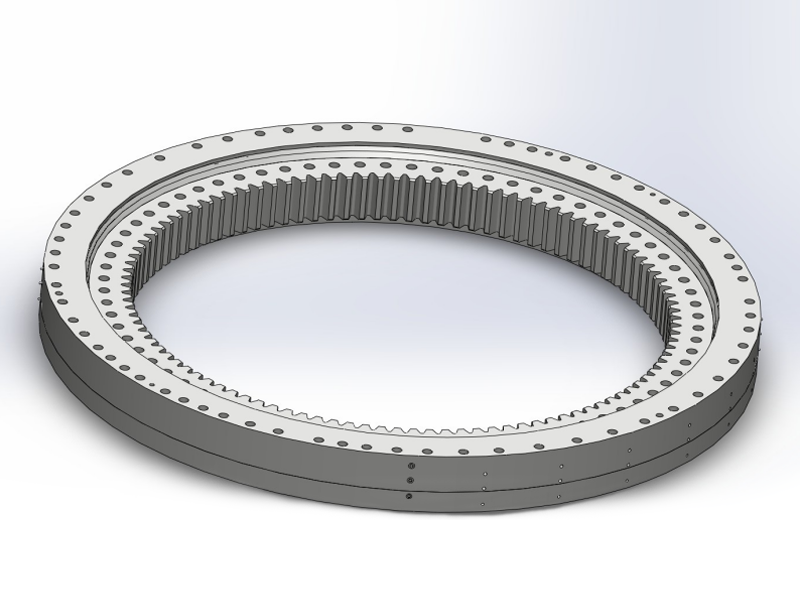
While the internal components of the swing gearbox manage rotational torque, the gearbox itself cannot physically bear the structural weight of the excavator. Instead, the gearbox's pinion gear meshes directly with a massive, external rotational platform. This is where a specialized 150-ton Swing Bearing for Large Excavator becomes the critical mechanical interface.
Take, for example, the rigorous demands of a 150-ton class machine. The slewing ring must handle extreme, simultaneous load combinations. It supports the massive axial weight of the upper structure, the radial centrifugal forces during rapid rotation, and the brutal overturning moments exerted when a fully loaded boom is extended. To survive this, premium components like the 134-45-2249 specification often utilize a three-row cylindrical roller design. This separates the axial and radial loads into different raceways, ensuring maximum structural integrity. As the internal swing gearbox operates, its pinion drives the teeth of this slewing ring. The synergy here is paramount. A failure in the internal gearbox will cause the pinion to misalign, rapidly destroying the external ring.
Despite their robust metallurgical construction, these components are wear items with finite lifespans. Recognizing the early empirical indicators of degradation can prevent catastrophic failure and weeks of costly operational downtime. A blown transmission doesn't just cost parts; it costs thousands in lost productivity.
Experienced maintenance technicians rely on specific diagnostic indicators to identify internal wear before it results in a complete lock-up:
Acoustic Emissions: Healthy machinery operates with a smooth, consistent hum. A whining or howling noise that changes pitch in direct correlation with engine RPM is often the first indicator of rolling element fatigue. A harsh grinding sound typically indicates that the internal cage has failed entirely.
Vibration Anomalies: Excessive mechanical vibration transmitted through the outer housing is a measurable symptom of internal clearance issues. When diagnosing massive external components like a Slewing Bearing for Excavator, industrial teams frequently use Fast Fourier Transform (FFT) vibration analysis. This detects specific frequency spikes that correlate to microscopic subsurface defects.
Thermal Irregularities: Failing components generate excess friction. This manifests as localized hot spots on the exterior casing, easily visible with a thermal imaging camera.
Understanding the root causes of mechanical failure is essential for implementing effective preventative maintenance strategies. Lubrication starvation is the leading culprit. Insufficient oil film thickness allows metal-to-metal contact, leading to micro-welding and rapid thermal degradation. Additionally, contamination from dirt or water acts as an abrasive paste that aggressively scores the polished raceways. Finally, consistent overloading beyond the manufacturer's rated capacity accelerates metal fatigue, causing subsurface micro-cracks that eventually flake away in a process known as spalling.
When engineering a new drive system or specifying replacement parts, selecting the correct component involves rigorous mathematical and environmental calculations. An undersized unit will suffer premature fatigue. Conversely, an oversized one adds unnecessary weight and parasitic friction.
The primary metrics for selection are the Dynamic Load Rating (C) and the Static Load Rating (C0). Engineers calculate the maximum torque output of the shafts and convert this into radial and axial forces. The chosen component must be capable of supporting these loads while maintaining its L10 design life. This is the statistically calculated lifespan at which 90% of a sample group will still be operational. Speed is equally critical. Operating beyond the limiting speed will cause the lubricant to break down rapidly due to extreme centrifugal forces.
Operational environments heavily dictate sealing and material requirements. A drive unit operating in a climate-controlled facility has vastly different requirements than one operating in an open-pit mine. For heavy-duty applications requiring heavy-duty excavator slewing rings, environmental protection is paramount. These high-tier components must feature advanced fluoroelastomer lip seals to prevent the ingress of abrasive silica dust and moisture, ensuring internal integrity under the harshest job site conditions.
When an internal component reaches the end of its service life, adhering to strict replacement protocols is vital to restore the equipment to factory specifications. Shortcuts here will cost you dearly later.
Because they undergo identical duty cycles within a shared oil bath, if one unit fails due to fatigue, the others are undoubtedly nearing the end of their operational lifespan. Best practice in industrial maintenance dictates that when a casing is dismantled for a failure, all supporting elements and seals should be replaced simultaneously. Replacing just one part is a false economy. It almost guarantees a secondary teardown a few months later.
Improper installation is responsible for a staggering percentage of premature failures. Technicians must avoid using steel hammers to force parts onto a shaft. Shock impacts cause "brinelling"—microscopic dents in the raceway caused by the rolling elements. This immediately compromises structural integrity before the machine even turns on. Instead, professionals utilize thermal induction heaters to safely expand the inner ring. This allows it to slide smoothly onto the shaft and lock into place as it cools.
Conclusion
Gearbox bearings are the critical foundation that maintains alignment, reduces internal friction, and safely transfers power. The exact number inside your machinery depends entirely on the specific architectural design, ranging from four in a simple reducer to dozens in a complex automotive transmission.
Heavy equipment relies on the seamless synergy between these internal drive components and massive external structures to achieve smooth, reliable rotation. Proper lubrication, proactive vibration monitoring, and timely maintenance are the absolute keys to extending the lifespan of these vital parts. Ignore them, and your equipment will quickly become a very expensive paperweight.
When it is time for maintenance, always choose high-quality replacements engineered for your specific load requirements. If you are servicing heavy construction machinery and want to eliminate costly downtime, ensure you source premium slewing bearings for large excavators from Masfy Slewing Ring to guarantee operational safety and long-term durability on the job site.
FAQ (Frequently Asked Questions)
No. They are a fundamental requirement for any enclosed gear system. Without them, the rotating steel shafts would rub directly against the stationary metal housing. This unmitigated friction would generate immense heat within seconds, causing the materials to gall, expand, and eventually weld together. Furthermore, without precise alignment support, the gear teeth would immediately bind and shatter under the torque load.
Lifespan is highly dependent on the application, load profile, and maintenance schedule. In industrial settings, heavy-duty units are typically engineered to achieve an L10 life of 10,000 to over 50,000 operating hours. In automotive applications, they are generally designed to last the lifetime of the vehicle (often exceeding 150,000 miles), provided the transmission fluid is replaced at recommended intervals to prevent contamination.
Manual transmissions predominantly utilize a combination of tapered roller bearings and needle roller bearings. Tapered designs are positioned at the ends of the main shaft and countershaft because they excel at handling the axial thrust forces generated by helical gears. Needle designs, which have a very slim profile, are typically installed under the individual speed gears, allowing them to spin independently when not engaged.
The most accurate method for identification is to locate the standardized alphanumeric part number laser-etched or stamped onto the outer or inner ring (e.g., 6205-2RS). If the number is worn away, you must consult the original equipment manufacturer's (OEM) service manual. Alternatively, a technician can use precision digital calipers to measure the inner diameter (ID), outer diameter (OD), and width, cross-referencing these dimensions with industrial catalogs to find the exact replacement.
Over-lubrication is just as destructive as under-lubrication. Packing too much grease or overfilling the oil bath causes a phenomenon known as "churning." The rolling elements have to push through the excess fluid, which creates immense fluid friction. This rapidly spikes the internal temperature, degrades the lubricant's viscosity, and can easily blow out the rubber lip seals due to increased internal pressure.
Yes, but it requires careful engineering consideration. Upgrading to a bearing with a higher dynamic load rating (such as switching from a standard ball bearing to a cylindrical roller bearing of the same dimensions) can increase durability. However, you must ensure that the new component does not negatively alter the internal clearance, shaft endplay, or the system's ability to dissipate heat. Always consult the OEM specifications before altering internal mechanical structures.

 +86-13955534080


