
T: +86-13955534080
E: salesb@masfy.com
E: salesb@masfy.com
West ChaoShan Road, Economic and Technical Development Zone, Maanshan,Anhui,China
Views: 0 Author: Site Editor Publish Time: 2026-10-20 Origin: Site


The swing mechanism serves as the operational heart of any earthmoving machine. When an excavator loses its ability to rotate smoothly, the entire job site comes to a grinding halt. Replacing this critical component costs valuable time, labor, and capital. Choosing the wrong specification during procurement doesn't just waste money. It causes rapid mechanical failure and introduces severe safety hazards to your crew.
Before making a high-stakes purchasing decision, fleet managers and heavy machinery mechanics must evaluate several structural factors. This guide strips away the marketing fluff. We will dive into the exact engineering tolerances, material grades, and operational physics required to source the correct rotational components, ensuring you balance upfront costs with long-term structural integrity.
Verify Exact Specifications: A successful drop-in replacement requires micrometer-level matching of the outer diameter, inner diameter, gear tooth profile, and dynamic load capacity.
Material Composition is Everything: Longevity relies entirely on the steel grade. High-quality 42CrMo forged alloys, paired with mid-frequency induction hardening, prevent raceway spalling under severe stress.
OEM vs. Premium Aftermarket: Top-tier aftermarket alternatives deliver performance parallel to original equipment at a fraction of the cost, provided the factory strictly adheres to ISO quality and ultrasonic testing standards.
Maintenance Dictates Lifespan: Even a flawlessly engineered ring will self-destruct without robust double-lip environmental sealing and a rigorous, documented greasing schedule.
Frequently referred to as a turntable bearing, this component is a massive rotational rolling-element joint. It acts as the vital mechanical bridge connecting the stationary undercarriage tracks to the rotating upper cab and boom. This specialized joint facilitates continuous 360-degree rotation while simultaneously managing complex, multi-directional load distributions.
Selecting a high-quality Slewing Bearing for Excavator applications goes far beyond just finding a bolt hole that lines up. The bearing must safely transfer the entire dynamic weight of the upper cabin—plus a fully loaded bucket at maximum reach—down to the chassis without buckling.
Mechanical failure in a swing mechanism rarely happens overnight. Operators should actively monitor for specific diagnostic symptoms during daily trenching or lifting. For instance, if an operator feels an unsettling "clunk" or a noticeable tilting sensation in the cab while swinging a heavy load of wet clay, the internal clearance of the bearing has likely exceeded safe factory tolerances.
Audible metallic grinding or popping noises during rotation indicate that the internal raceway has sustained physical surface damage. Furthermore, finding brass or steel flakes during a routine grease purge is a glaring red flag of internal metal-on-metal degradation. Jerky, stuttering swing movements often point to unevenly worn gear teeth or a failing hydraulic motor pinion interface.
Heavy earthmoving relies on brutal physics. Unlike standard industrial bearings that typically handle a single downward load trajectory, an excavator's bearing must concurrently fight three distinct forces. Beyond handling static downward weights (axial loads), the component must counteract the radial loads generated by the centrifugal force of a rapid swing.
Specifically, the most destructive forces are the extreme tilting moments. When the boom is fully extended and the bucket bites into dense rock, the resulting leverage creates a severe overturning moment. This force literally attempts to pry the upper structure off the tracks. A bearing with an inadequate load rating or shallow raceway depth will rapidly deform under these leverage stresses.
Recent shifts in earthmoving attachments have drastically changed how engineers spec these rings. Today, operators are increasingly mounting heavy aftermarket hydraulic breakers, mulchers, and vibratory compactors onto standard excavator chassis. This trend has multiplied the dynamic shock loads transmitted through the swing mechanism.
Consequently, the industry is moving away from generic replacements. Fleet managers are now demanding application-specific bearings engineered with deeper induction-hardened raceways and specialized double-lip NBR seals to handle aggressive urban demolition environments. In contrast to the past where OEM was the only trusted route, the rise of compact urban construction has fueled a specific niche: ultra-durable, high-tolerance aftermarket bearings that fit into the incredibly tight spatial footprints of mini excavators without sacrificing a single pound of load capacity.
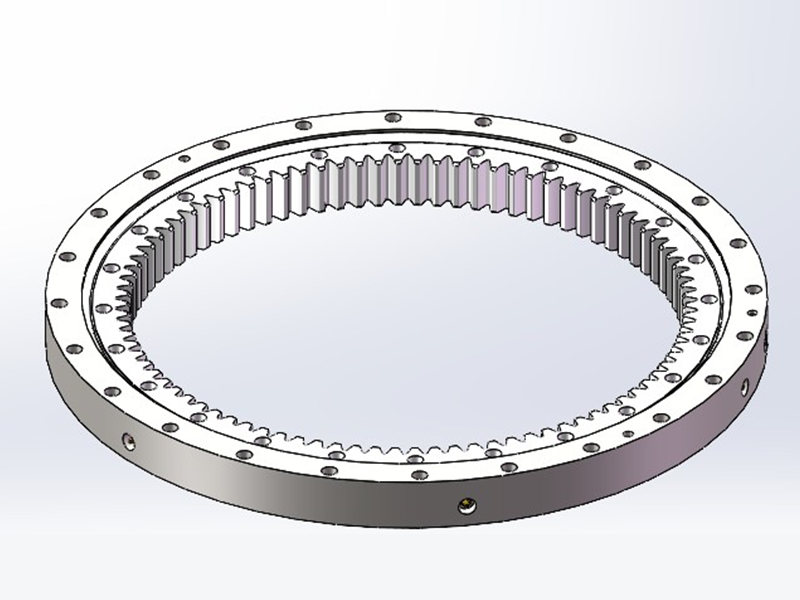
Procuring a replacement is not a guessing game. It requires exact mechanical matching. Buyers must thoroughly understand key engineering specifications to ensure the new part functions safely and integrates seamlessly with the existing hydraulic pinion.
The operating weight of the machinery dictates the required bearing profile. The internal geometry, roller size, and raceway depth are engineered specifically for that machine's duty cycle. For example, when sourcing a 1.8-ton swing bearing for mini excavator fleets, you might look at specific profiles like the QNB400.18. This isn't just a shrunken version of a 30-ton bearing. It features an optimized cross-section designed for rapid, jerky residential landscaping movements while maintaining a tight spatial footprint. Installing a bearing rated for a lower tonnage will result in immediate raceway spalling.
Earthmoving equipment almost exclusively utilizes internal geared bearings, where the teeth mesh directly with the pinion gear of the hydraulic swing motor. When evaluating a replacement, the tooth profile must be an identical clone of the original equipment. This exactness includes the gear module (the ratio of the pitch diameter to the number of teeth), the total tooth count, and the pressure angle. Even a half-millimeter mismatch in the gear profile will cause immediate binding and rapid shearing of the swing motor pinion.
Precise dimensional measurement is the most critical step. If you lack the OEM blueprint, you must verify these physical dimensions using a precision caliper or micrometer before finalizing an order.
Measurement Parameter | Engineering Definition | Field Consequence if Mismatched |
|---|---|---|
Outer Diameter (OD) | Total measurement across the widest external point. | Friction against the undercarriage housing; inability to drop the cab onto the chassis. |
Inner Diameter (ID) | Measurement across the internal void of the inner ring. | Crushing of the central rotary joint; pinched hydraulic lines causing massive fluid leaks. |
Overall Assembly Height | Total vertical thickness of the assembled inner and outer rings. | Incorrect pinion gear engagement depth, leading to stripped gear teeth. |
Bolt Hole Pattern (PCD) | Quantity, diameter, and Pitch Circle Diameter of all mounting holes. | Total installation failure. The structural alignment will be completely compromised. |
The metallurgical composition and heat treatment processes are the primary differentiators between a component that lasts 10,000 hours and one that self-destructs after a single season of hard labor.
The structural integrity of a reliable excavator slewing bearing begins with the raw steel billet. Standard 50Mn (Manganese Steel) offers adequate tensile strength and is cost-effective for standard-duty applications. However, if your fleet handles heavy rock breaking or mining, 42CrMo (Chromium-Molybdenum) is the mandatory premium standard. It provides superior fatigue resistance and excellent shock absorption, making it highly resistant to micro-cracking under repetitive impact.
Raw steel alone cannot withstand the immense friction generated by the rolling elements. The internal raceways and the gear teeth must undergo specialized heat treatment. Quality manufacturers utilize mid-frequency induction quenching. This advanced process rapidly heats specific contact areas of the steel before immediately quenching it. This hardens the surface to a precise 55-60 HRC to resist wear, while leaving the core of the steel tough and ductile to absorb shock impacts without shattering.
The operational lifespan of your new swing ring is determined just as much by the installation procedure in the shop as it is by the manufacturing quality at the foundry.
Structural failure often occurs at the mounting interface, not within the bearing itself. The bearing must be mounted to a perfectly flat, machined surface. More importantly, never reuse old mounting bolts. Invisible metal fatigue means a used bolt can easily snap under a heavy load. Always install brand new, high-strength Grade 10.9 or 12.9 bolts. These must be tightened using a calibrated torque wrench in a specific crisscross star pattern, adhering strictly to the OEM torque values.
Friction is the ultimate enemy. A strict lubrication schedule is your only defense against premature failure. Operators must use high-quality, extreme-pressure (EP) lithium-based grease. The internal raceway generally requires greasing every 50 operating hours, while the internal gear teeth need fresh lubrication every 8 to 10 hours of heavy operation. Crucially, greasing must be performed while the machine is slowly rotating. Pumping grease into a stationary bearing only lubricates one small section, leaving the rest of the raceway bone dry.
The final step in the procurement process is vetting the manufacturer. A reliable vendor acts as a technical partner, not just a parts distributor pushing boxes out of a warehouse. They should provide detailed engineering drawings (like the QNB400.18 specs) for your mechanics to confirm against the physical machine, virtually eliminating the risk of shipping a structurally incompatible component.
Are you looking for a precise, drop-in replacement part that won't destroy your maintenance budget? Whether you are managing a heavy-duty quarry fleet or need a highly specialized Slewing Bearing for Excavator applications in compact urban sites, partnering with a trusted manufacturer is critical. Explore the engineered solutions at MASFY (masfy-slewingring.com) to find the exact metallurgical fit for your machine, backed by rigorous quality control, and get your job site back to full production.
Under standard operating conditions, a well-maintained swing ring generally lasts between 5,000 to 10,000 operating hours. This lifespan is heavily dependent on strict adherence to daily lubrication schedules, the intensity of the loads lifted, and the severity of the abrasive dust in the operating environment.
Mechanics typically perform a "tilt test" using a magnetic dial indicator. Mount the indicator base on the undercarriage and rest the needle against the outer edge of the upper structure. Have the operator push the bucket firmly into the ground to lift the front of the tracks slightly, then release. If the vertical play exceeds the manufacturer's maximum allowable tolerance (often around 1.5mm to 3mm depending on machine size), the bearing is worn out.
Minor maintenance, such as replacing torn upper or lower rubber dust seals, is possible and highly recommended. However, if the internal raceway or the gear teeth are pitted, cracked, or heavily worn—evidenced by metal shavings in the grease—a full replacement is absolutely mandatory to ensure job site safety.
Costs vary drastically based on machine tonnage and whether you choose OEM or premium aftermarket. A bearing for a 1.8-ton mini excavator may range from $400 to $900, while a ring for a 30-ton machine can cost between $2,500 and $6,000+. Remember to factor in the labor costs and crane rental required to lift the cab off the undercarriage, which often exceeds the price of the part itself.
If the OEM part number is rusted over or illegible, you must use a precision caliper to measure the Outer Diameter (OD), the Inner Diameter (ID), and the total assembly height. Furthermore, you must count the exact number of internal gear teeth and document the Pitch Circle Diameter (PCD) of the mounting holes on both the inner and outer rings.
The most frequent causes of premature catastrophic failure include a lack of consistent EP grease lubrication, consistently overloading the machine with oversized attachments, abrasive dust ingress due to degraded rubber seals, and operating the machine with loose or improperly torqued mounting bolts.

 +86-13955534080


