
T: +86-13955534080
E: salesb@masfy.com
E: salesb@masfy.com
West ChaoShan Road, Economic and Technical Development Zone, Maanshan,Anhui,China
Views: 0 Author: Site Editor Publish Time: 2026-10-30 Origin: Site


Heavy machinery operates under massive physical stress in some of the most unforgiving environments on the planet. At the heart of this mobility lies the rotation bearing. This critical junction supports the entire operational load of the superstructure. When procurement teams or engineers select an inadequate bearing, or neglect fundamental maintenance protocols, sudden equipment failure becomes inevitable. Consequently, this leads to severe safety risks on the job site, stalled project timelines, and exorbitant downtime costs.
Fleet operators and engineering managers face a constant battle against wear and tear. Knowing exactly how to evaluate, select, and maintain the ideal rotational components is the only way to maximize machinery lifespan and ensure seamless daily operations.
Core Functionality: Heavy-duty rotation bearings handle massive axial, radial, and moment loads simultaneously. They serve as the rotational backbone of excavators and cranes.
Machinery Matching: Selecting the correct design configuration strictly depends on the weight class and dynamic operational demands of the equipment.
Preventative Maintenance: Proper sealing, specialized extreme-pressure lubrication, and routine bolt tensioning are critical to overcoming premature wear.
Supplier Evaluation: Partnering with specialized manufacturers ensures procurement teams receive OEM-quality components that undergo rigorous non-destructive testing.
Making highly informed procurement and engineering decisions requires a deep understanding of fundamental mechanics. Unlike standard industrial bearings, a heavy-duty rotation bearing is specifically designed to accommodate combined, multi-directional loads. This facilitates smooth, continuous, or oscillating 360-degree movement under extreme pressure.
The structural integrity of this mobility hub relies on several precisely engineered elements working in perfect unison. First, the inner and outer rings form the foundation. Forged from high-alloy steel, one ring is securely bolted to the stationary undercarriage of the machinery, while the counterpart attaches directly to the rotating cabin. Typically, one of these rings features integrated gear teeth to interface seamlessly with the drive motor.
Situated tightly between these steel rings are the rolling elements. These can be either spherical balls or cylindrical rollers. As these elements travel along induction-hardened raceways, they drastically reduce metal-on-metal friction. Furthermore, heavy construction sites are highly contaminated environments. Industrial-grade nitrile rubber seals are integrated into the ring gaps to aggressively block the ingress of silica dust, mud, and moisture. Strategically placed ports allow technicians to inject fresh grease directly into the internal geometry.
During active operation, this component acts as the singular physical connection point between a machine tracks and its working arm. When an excavator digs deep into compacted earth, it generates violent, off-center forces known as moment loads. The internal rolling elements immediately distribute these intense forces evenly across the hardened steel raceway. By actively managing the friction between the stationary base and the moving parts, the bearing allows the upper cabin to rotate effortlessly while simultaneously supporting the dead weight of the machine and its heavy payload.
Not all infrastructure projects require the exact same level of load-bearing capacity. Mechanical engineers categorize these components based on the internal configuration of their rolling elements. Selecting the appropriate structural type is a high-stakes decision for fleet operators.
This represents the most common and cost-effective configuration for light to medium equipment. The internal design features a single row of steel balls that make precise contact with the raceway at four distinct points. This unique geometry allows the bearing to handle downward, horizontal, and moderate tilting loads simultaneously. It is typically specified for mini-excavators, small utility cranes, and hydraulic attachments where extreme lifting weight is not the primary limiting factor.
In contrast, machinery requiring significantly higher static load capacities and superior resistance to harsh directional changes utilizes double-row ball bearings. By distributing the mechanical stress across two independent rows of spherical balls, this design offers enhanced structural stability. It delivers a much longer operational lifespan under continuous, repetitive stress. These are frequently installed in medium-sized lifting equipment and scrap material handlers.
When engineering teams tackle massive infrastructure projects, the three-row roller bearing is the undisputed heavyweight champion. Instead of utilizing balls, this highly specialized design uses three independent rows of cylindrical rollers. The upper and lower rows absorb the crushing downward weight and tilting moments, while the middle row strictly manages horizontal side-forces. Because rollers provide flat line contact rather than pinpoint contact, their load-carrying capacity is exponentially higher.
For procurement teams outfitting massive earthmovers, selecting a premium Slewing Ring for Construction featuring a three-row roller design is the ultimate solution to prevent catastrophic structural deformation.
Bearing Configuration | Load Handling Capability | Ideal Machinery Match | Relative Cost |
|---|---|---|---|
Single-Row 4-Point Contact | Moderate axial and radial loads | Mini-excavators, light cranes | Low to Medium |
Double-Row Ball Bearing | High static load, harsh directional shifts | Medium excavators, scrap handlers | Medium to High |
Three-Row Roller Bearing | Extreme crushing weight and tilting moments | 200-ton excavators, heavy tower cranes | High Investment |
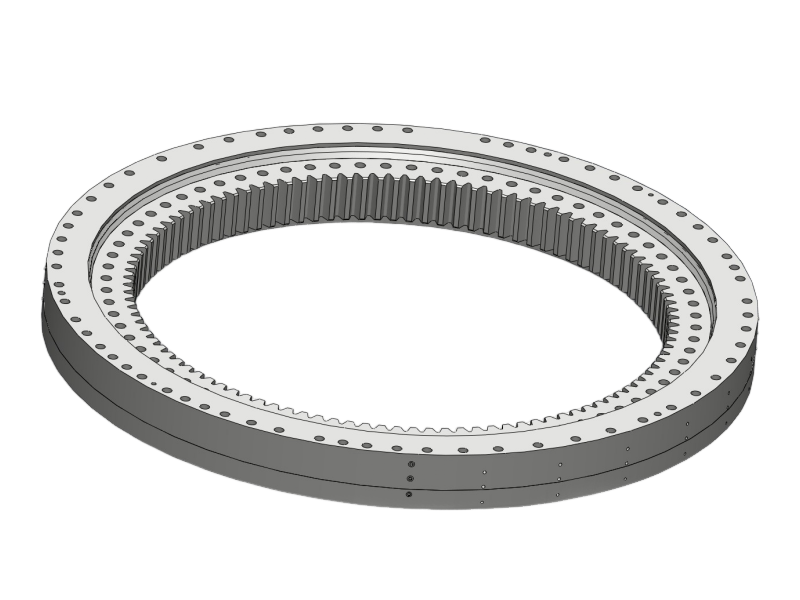
Field application always dictates strict engineering specifications. Purchasing managers must meticulously align the physical properties of the aftermarket part with the exact, unforgiving requirements of the heavy machinery.
Heavy excavators operate in brutal, unrelenting conditions. They endure continuous 360-degree rotation, extreme hydraulic shock loads from blasting through solid rock, and relentless engine vibration. The rotational bearing in a massive excavator must support the entire dynamic weight of the upper structure, the extended boom, the heavy steel bucket, and tons of excavated material. All of this must happen while maintaining pinpoint rotational control for the operator.
Upgrading or replacing failing components for massive earthmovers requires highly specialized, high-capacity parts that meet or exceed original specifications. For example, a 200-ton class machine demands specific parameters, such as an outer diameter reaching 2840mm and a robust gear module. Sourcing a dedicated Slewing Ring for Construction 200-ton Excavator guarantees the structural integrity required to handle immense tilting moments without suffering from raceway micro-cracking.
In high-altitude lifting operations, the safety aspect of these bearings cannot be overstated. Tower cranes and mobile cranes rely entirely on these components to lift multi-ton steel beams and concrete blocks high into the air. The moment load, which is the physical tendency of the crane to tip over, is transferred directly to the gear teeth and internal raceway. Therefore, crane applications require extremely precise gear machining tolerances and specialized core hardening to prevent catastrophic, life-threatening structural failures during active load distribution.
Standard industrial bearings used in factory settings are entirely insufficient for the heavy construction sector. The rigorous engineering requirements for earthmoving machinery demand specialized metallurgical processes and highly precise load management capabilities.
A true heavy-duty bearing must simultaneously manage three distinct types of destructive forces. Axial loads represent the vertical downward force, which includes the dead weight of the steel superstructure and the actual payload. Radial loads are the horizontal forces acting perpendicular to the axis of rotation, often caused by rapid centrifugal force during a swing or extreme wind pressure against a crane boom. Finally, moment loads are the overturning or tilting forces generated when a heavy load is lifted far away from the machine natural center of gravity. Specialized contact angles and internal geometries are engineered specifically to neutralize these combined forces safely.
Imagine an excavator bucket violently striking a hidden granite boulder mid-swing. That sudden, violent shockwave travels directly down the boom and into the rotation bearing. To withstand this daily abuse, the raceways and gear teeth undergo advanced induction hardening. This intense heat treatment process increases the surface hardness, typically reaching 55 to 60 HRC, to resist abrasive wear and structural deformation. Crucially, it leaves the inner core of the steel tough and ductile, allowing it to absorb massive impact energy without shattering.
Analyzing current industry trajectories reveals a distinct shift in heavy construction projects toward predictive maintenance and advanced metallurgy. As modular construction techniques demand lifting increasingly heavier prefabricated components, rotational bearings are forced to evolve. Industry analysts note a rising adoption of integrated condition-monitoring sensors. These systems monitor rotational friction and acoustic emissions in real-time, alerting operators to internal spalling long before a catastrophic failure occurs. Furthermore, leading manufacturers are transitioning to specialized micro-alloyed steels that offer superior fatigue resistance. This technological leap ensures that today heavy-duty bearings are not just passive structural elements, but active components in overall fleet health management.
For procurement managers and fleet engineers, the failure of a critical bearing is not merely a mechanical nuisance. It is a full-blown logistical crisis. Understanding exactly why these components fail and calculating the true cost of subpar alternatives is the first step toward optimizing long-term fleet performance.
Surprisingly, the leading cause of component failure in construction environments is not necessarily overloading, but severe contamination. Job sites are inherently saturated with abrasive elements such as fine silica dust, wet mud, gravel, and standing water. When aftermarket parts are manufactured with inferior, budget-tier sealing systems, these aggressive contaminants easily bypass the protective barriers and enter the sensitive raceway.
Once inside, the silica and dirt mix with the internal lubricating grease, creating a highly abrasive grinding paste. This paste continuously grinds against the rolling elements and the hardened steel raceway. Over a short period, this leads to micro-pitting, spalling, and eventually, the complete destruction of the bearing internal geometry. High-quality alternatives mitigate this severe risk by utilizing advanced labyrinth designs or heavy-duty nitrile rubber seals specifically formulated to maintain positive internal pressure and block external debris.
When quarterly budgets are tight, procurement teams may be tempted to source lower-cost, unverified alternatives or refurbished rings. However, this short-sighted approach frequently results in the dreaded costly replacement dilemma.
The initial purchase price of a replacement part represents only a tiny fraction of the total cost of a breakdown. When a bearing fails on a massive excavator, the operational downtime is immediate and brutal. The replacement process requires mobilizing separate heavy lifting equipment just to dismantle the superstructure from the undercarriage, consuming hundreds of expensive man-hours. The financial impact of a stalled project, combined with emergency labor costs, far outweighs the initial savings of buying a cheap part. Investing in a premium construction slewing ring upfront ensures that the component is engineered with the correct material hardness, drastically reducing the total cost of ownership over the machine operational lifespan.
Selecting the correct replacement requires a meticulous, detail-oriented evaluation of mechanical specifications and manufacturer capabilities. A slight mismatch in load capacity or gear configuration can quickly lead to binding, accelerated wear, or catastrophic equipment failure.
Engineers must ensure that the replacement perfectly matches the original equipment specifications. This goes far beyond simply measuring the physical dimensions with a tape measure. Procurement teams must verify the dimensional accuracy, including the precise outer diameter, inner diameter, and overall height. Additionally, they must audit the gear data. Verifying the number of gear teeth, the module, and the pressure angle prevents the drive pinion from grinding during rotation. Finally, the quantity, size, and exact distribution of the mounting holes on both the inner and outer rings must be identical to ensure proper bolt tensioning.
Not all industrial manufacturers operate to the same rigorous standards. When sourcing critical components for massive machinery, the supplier engineering and quality assurance processes must be thoroughly vetted. Buyers should verify that the manufacturer holds relevant ISO 9001 certifications and utilizes certified forged steel, such as 42CrMo or 50Mn.
Furthermore, reliable suppliers employ strict non-destructive testing protocols. They utilize ultrasonic testing to detect hidden internal flaws in the steel forgings, and magnetic particle inspection to identify microscopic surface cracks after heat treatment. When upgrading a massive machine, sourcing a tailored heavy-duty slewing ring for construction from a specialized supplier ensures that the raceways are induction-hardened to the exact depth required to withstand extreme, repetitive shock loads.
Even the most precisely engineered and expensive bearing will fail prematurely if subjected to improper or lazy maintenance. Establishing strict, routine maintenance protocols is the single most effective way to protect your heavy machinery investment. This diligence can extend the operational life of the component to 10,000 or even 15,000 hours.
Lubrication serves a vital dual purpose. It minimizes internal friction and acts as a secondary fluid barrier against outside contamination. Standard, off-the-shelf grease is entirely insufficient for heavy construction environments. Maintenance teams must use extreme-pressure lithium-based greases formulated with solid lubricants, like molybdenum disulfide, to handle crushing loads.
When greasing the raceway, the machine should be rotated slowly while grease is pumped into the fittings to ensure an even, 360-degree distribution. The standard field protocol is to pump fresh grease until the old grease visibly purges from the rubber seals. This effectively pushes out any trapped dirt or moisture. The external or internal gear teeth must be lubricated separately with a highly adhesive compound that will not wash away in heavy rain or fling off during rapid swings.
High-tensile bolts secure the massive steel rings to the machinery chassis. These bolts are subjected to continuous stretching, pulling, and engine vibration. If even a single bolt loses its tension, the operational load is immediately transferred unevenly to the adjacent bolts. This creates a dangerous domino effect that can lead to rapid bolt shearing and permanent bearing deformation.
Operators must use calibrated torque wrenches to check bolt tension after the first 100 hours of operation for newly installed parts, and routinely every 500 hours thereafter. Bolts should always be tightened in a cross-pattern to ensure perfectly even pressure distribution across the mounting surface.
Fleet technicians must be highly trained to recognize the early warning signs of structural degradation. Catching a failing component early prevents catastrophic job site accidents and secondary damage to expensive hydraulic swing motors.
Key indicators of failure include excessive clearance or play in the upper cabin, which suggests severe internal wear. Smooth operation is a sign of a healthy machine. Any audible grinding, popping, or crunching sounds during rotation indicate that the rolling elements are actively spalling. Finally, if maintenance crews discover metallic silver flakes or steel shavings in the purged grease during routine maintenance, it is a definitive sign of internal structural destruction. The machine must be taken out of service immediately.
The rotation bearing is the undeniable heart of heavy machinery mobility. Choosing the right design configuration dictates the overall success, profitability, and safety of a construction project. By understanding the engineering demands, avoiding cheap alternatives, and adhering to strict lubrication and tensioning protocols, fleet operators can prevent costly downtime. If your fleet requires robust, precision-engineered solutions tailored for extreme environments, explore high-performance options at Masfy Slewing Ring to keep your heavy-duty construction projects moving forward smoothly.
The operational lifespan heavily depends on strict maintenance routines, environmental conditions, and total operational hours. However, a well-maintained, high-quality component operating under normal construction conditions can typically last between 10,000 to 15,000 operating hours before requiring a full replacement. Consistent greasing and routine bolt torque checks are the best ways to maximize this lifespan.
Minor peripheral issues, such as degraded rubber seals or superficial lubrication blockages, can often be repaired directly in the field. However, if there is structural damage to the internal raceway, spalling of the steel rolling elements, or broken gear teeth, the bearing almost always requires a complete replacement to maintain operational safety and structural integrity on the job site.
For heavy construction machinery operating in harsh environments, it is highly recommended to use a heavy-duty, extreme-pressure lithium-based grease. Greases containing solid friction-reducing additives like molybdenum disulfide are ideal, as they provide an extra layer of durable protection against the extreme metal-on-metal friction and high shock loads experienced during digging.
Massive machines generate immense moment tilting loads during heavy lifting and deep trenching operations. Three-row roller designs are specifically engineered to handle these extreme forces by separating the axial, radial, and moment loads across three distinct rows of cylindrical rollers. This prevents the severe structural deformation that would quickly destroy standard single-row ball bearings under the same weight.
To correctly identify and order a replacement, you must precisely measure the outer diameter, inner diameter, and the overall height of the steel rings. Additionally, you must accurately count the exact number of gear teeth, note the gear position, and count the number and size of the mounting bolt holes on both rings. Always cross-reference these physical measurements with the original equipment part number to guarantee a perfect fit.
The earliest indicators of failure include unusual noises such as popping, grinding, or clicking during rotation. Operators may also notice increased rocking or excessive play in the upper cabin when the machine stops suddenly. Finding metal flakes in the purged grease is a critical warning sign that the internal raceway is actively deteriorating.
Extreme temperatures significantly impact bearing performance. High heat can cause standard grease to thin out and leak, reducing lubrication efficacy, while freezing temperatures can cause grease to harden, increasing rotational resistance. Specialized temperature-rated greases and thermal expansion allowances in the bearing design are required for machinery operating in extreme climates.

 +86-13955534080


