
T: +86-13955534080
E: salesb@masfy.com
E: salesb@masfy.com
West ChaoShan Road, Economic and Technical Development Zone, Maanshan,Anhui,China
Views: 0 Author: Site Editor Publish Time: 2026-10-12 Origin: Site


Have you ever watched a 20-ton excavator spin flawlessly on a crowded, uneven job site? It is a genuine marvel of mechanical engineering. One hidden, massive joint makes this seamless 360-degree motion possible. However, when this critical component fails, your machine grinds to a halt, and project delays begin to bleed serious money. In this comprehensive guide, we will explore the intricate anatomy of slewing rings, dissect their structural mechanics, and provide actionable, field-tested insights on replacement options to keep your heavy equipment operational.
Core Definition: A slewing ring is a large rotational rolling-element bearing engineered specifically to support heavy, slow-turning, and highly complex loads.
Internal Anatomy: A standard structural breakdown reveals a stationary inner ring, a rotating outer ring, internal rolling elements (balls or rollers), protective spacers, heavy-duty seals, and integrated gear teeth.
Excavator Application: This bearing acts as the solitary mechanical anchor connecting the stationary undercarriage to the rotating upper structure. It enables precise, full-circle articulation under extreme stress.
Maintenance is Non-Negotiable: Strict adherence to regular greasing intervals and routine bolt-torque checks prevents the vast majority of premature bearing failures in the field.
Buyer’s Insight: When replacing a bearing, matching the exact machine tonnage, metallurgical grade, and gear profile is an absolute requirement to maintain structural integrity.
In the realm of heavy mechanical engineering, a slewing ring—frequently referred to as a turntable bearing—is an oversized, highly specialized component designed to manage complex load combinations simultaneously. Unlike simple shaft bearings that only handle weight in a single direction, a slewing ring accommodates axial loads (the sheer downward dead weight of the machine), radial loads (side-to-side lateral forces), and massive tilting moments (the extreme leverage created when a machine extends a heavy payload outward). Consequently, it serves as the primary rotational foundation for heavy machinery.
Looking at current industry trends, the heavy machinery sector is witnessing a definitive shift toward predictive maintenance and enhanced metallurgical standards. Global infrastructure demands are pushing manufacturers to develop components with higher structural resilience in more compact footprints. Advanced heat-treatment processes and deeper raceway hardening are becoming the new baseline. Because minimizing unplanned downtime is now the primary driver in fleet management, sourcing a reliable Slewing Bearing for Excavator with verified high-frequency quenching is critical for modern earthmoving operations.
Understanding the fundamental distinction between standard bearings and slewing rings is vital for proper machinery diagnostics. Standard bearings, such as those found in automotive wheel hubs or high-speed electric motors, are typically compact. They are press-fit onto a central shaft and engineered for rapid, continuous rotation. In stark contrast, slewing rings are massive, entirely lack a central shaft, and are purpose-built for slow, punishing, oscillating movements.
Feature | Standard Bearing | Slewing Ring (Turntable Bearing) |
|---|---|---|
Primary Application | High-speed, low-to-medium load rotation. | Slow-speed, extremely high-load oscillation. |
Mounting Method | Press-fit onto a central shaft. | Bolted directly to flat structural surfaces. |
Load Capacity | Usually handles one load type (axial or radial). | Handles axial, radial, and tilting moments simultaneously. |
Gearing | Rarely includes integrated gears. | Frequently features internal or external gear teeth. |
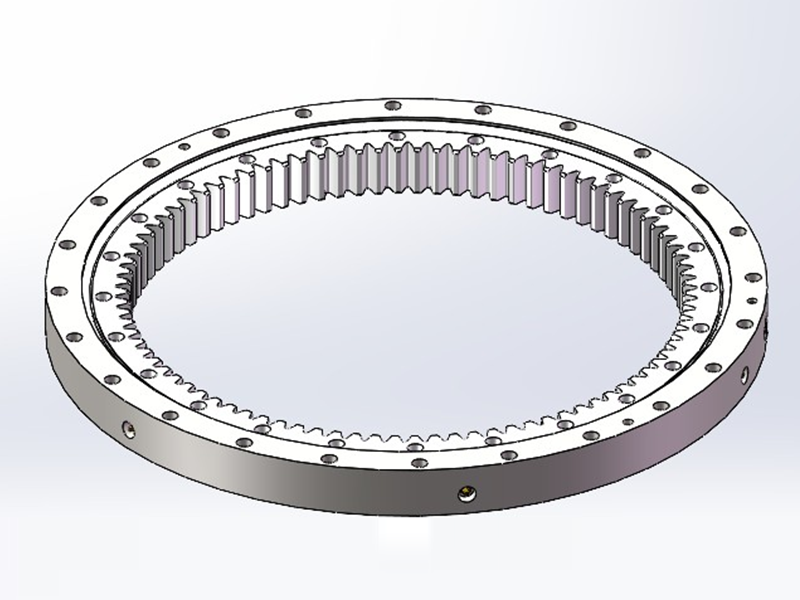
To accurately diagnose machinery issues, technical personnel must visualize the internal anatomy of this component. The structural design reveals a highly engineered assembly built for maximum durability under extreme, repetitive stress.
The foundation consists of two massive forged steel rings. Typically, one ring is bolted securely to the stationary base of the machine (the track undercarriage), while the corresponding ring is fastened to the rotating platform (the cab and engine housing). These rings contain precisely CNC-machined raceways. These deeply hardened grooves are exactly where the rolling elements travel.
Sandwiched securely between the inner and outer rings are the rolling elements. They drastically reduce friction during heavy rotation. Depending on specific load requirements, these can be hardened steel balls or cylindrical rollers. For heavy-duty earthmoving, engineers frequently utilize cross-roller designs or double-row ball configurations. These specific geometric designs maximize the contact area within the raceway, effectively distributing extreme stress. Furthermore, nylon spacers or brass cages are strategically placed between these elements to prevent them from grinding against one another.
A defining feature visible on almost any heavy-duty turntable bearing is the integration of gear teeth. These teeth can be machined directly into the inner ring or the outer ring. In a standard excavator setup, the hydraulic swing motor features a smaller pinion gear that meshes directly with the bearing's teeth. As hydraulic pressure forces the swing motor to turn the pinion, it drives the gear teeth, compelling the entire upper structure to rotate.
The true engineering test of an excavator bearing occurs during active, aggressive digging operations. Picture an excavator perched on a steep embankment. The operator fully extends the boom to scoop a bucket full of dense, wet clay. This action creates a severe lever effect. The weight at the end of the boom forcefully attempts to pull the cab forward. Meanwhile, the heavy cast-iron counterweight at the rear resists, trying to pull it backward. This violent opposing force creates a massive "tilting moment." The rotational joint acts as the ultimate anchor, safely absorbing these extreme leverage forces.
Beyond raw structural strength, the bearing provides crucial operational precision. Trenching alongside a highway or loading high-sided dump trucks requires smooth, continuous rotation. A properly functioning joint ensures the operator can swing the cab with millimeter precision. Any hesitation, binding, or unexpected jerking severely compromises both site safety and daily operational efficiency.
Machinery operators must remain constantly vigilant for signs of degradation. Because these components are subjected to immense stress, eventual wear is inevitable. Identifying failure early prevents catastrophic breakdowns in the middle of a critical project.
The most definitive physical indicator of a worn bearing is excessive "play" or clearance. Over thousands of operational hours, the hardened steel balls and the raceway slowly wear down due to friction. This creates a physical gap inside the bearing. When the operator halts the swing motion, the cab shouldn't shudder. If you notice a distinct rocking motion when downward bucket pressure is applied, this indicates severe raceway degradation. Maintenance technicians accurately measure this wear using a magnetic dial indicator. If the vertical play exceeds the manufacturer's tolerance, replacement is mandatory.
A healthy machine hums quietly during a swing cycle. Conversely, if you catch harsh grinding, abrupt popping, or distinct metallic clicking echoing from the machine's core, structural degradation is already underway. These alarming metal-on-metal sounds typically indicate that the internal rolling elements have fractured. If ignored, a failing 20-ton Slewing Bearing for Excavator will eventually lock up, potentially damaging the hydraulic swing motor.
Routine maintenance provides an excellent opportunity for early diagnostics. When pumping new grease into the bearing, old grease is naturally purged past the rubber seals. Do not simply wipe this away. Inspect it closely. The presence of shiny metal flakes or coarse steel shavings is a critical warning sign. It provides undeniable physical evidence that the internal raceway is actively disintegrating.
Selecting a replacement is not a process that allows for guesswork. The mechanical integrity of the entire machine relies on precise engineering compatibility. When an operator needs to procure a new component, meticulously evaluating specific technical parameters ensures operational safety.
The primary metric for selection is the operating weight of the machine. For mid-sized construction equipment, the 20-ton class is widely considered an industry standard. Machines in this category require highly specific raceway hardening depths.
When evaluating aftermarket options, the focus must remain entirely on material specifications. Procuring a well-documented component, such as the QND1220-32Z7-CZ Slewing Bearing for Excavator, provides equivalent mechanical reliability to OEM parts while optimizing the maintenance budget. The critical factor is verifying that the manufacturer utilizes premium 50Mn or 42CrMo steel. Furthermore, the raceway must undergo high-frequency induction quenching to achieve a hardness of 55-60 HRC. Low-tier aftermarket parts made from untreated A3 steel will fail rapidly under heavy tilting moments.
Specification Parameter | Premium Standard (e.g., QND1220-32Z7-CZ) | Low-Tier Aftermarket Risk |
|---|---|---|
Primary Base Material | 42CrMo / 50Mn | A3 Steel / 45# Steel |
Raceway Quenching Hardness | 55-60 HRC | < 50 HRC (Prone to spalling) |
Flaw Detection Testing | Ultrasonic (UT) & Magnetic Particle | Visual inspection only |
A slewing ring cannot function if it does not physically align with the undercarriage. Technical personnel must rigorously verify the gear tooth profile (ensuring it meshes perfectly with the swing motor's pinion gear). Additionally, the bolt hole alignment—specifically the quantity, diameter, and pitch circle diameter (PCD)—must be an exact match. A deviation of even one millimeter will render the bearing useless.
The operational lifespan of a heavy-duty rotational bearing is heavily dictated by the maintenance protocols implemented immediately after installation. Even the highest-grade metallurgical components will degrade rapidly if subjected to improper lubrication.
To maximize the lifespan of your excavator slewing bearing, lubrication must be treated as a priority. It minimizes metal-to-metal friction and acts as a secondary fluid barrier against contaminants. Standard operating procedures dictate the use of Extreme Pressure (EP) lithium-based grease, typically NLGI Grade 2, formulated specifically with molybdenum disulfide.
Crucially, when greasing the raceway, technicians must slowly rotate the excavator's upper structure. Injecting grease into a stationary bearing creates localized pressure zones. This mistake can easily blow out the delicate rubber seals while leaving the opposite side of the raceway completely dry.
The bearing is secured using high-tensile strength bolts (typically Grade 10.9 or 12.9). Installation requires tightening these bolts in a specific crisscross or "star" pattern using a calibrated hydraulic torque wrench. Following installation, the first torque verification must occur after 100 hours of initial operation.
Additionally, the nitrile butadiene rubber (NBR) seals are the absolute first line of defense. Excavators operate in highly abrasive environments. If a seal tears, silica sand will infiltrate the raceway. Once sand mixes with the internal grease, it forms a highly abrasive lapping compound that systematically grinds away the hardened steel. Inspect these seals weekly.
The slewing ring is the unsung hero of heavy machinery stability. Understanding its complex design empowers operators to perform proactive, evidence-based maintenance. Ignoring early warning signs—such as cab wobble or metallic grinding—inevitably causes cascading mechanical failures that ruin project timelines. If your machine is showing signs of wear, do not wait for a catastrophic failure. Always verify exact tonnage and gear specifications, and explore precision-engineered replacements to find the exact Slewing Bearing for Excavator for your fleet at MASFY, ensuring your demanding projects move forward without interruption.
Under standard operating conditions and strict adherence to maintenance protocols, a high-quality turntable bearing typically lasts between 5,000 and 10,000 operating hours. However, machines operating in highly corrosive environments, submerged conditions, or continuous heavy-rock lifting applications may experience a significantly reduced component lifespan. Consistent greasing is the primary variable that extends this timeframe.
Once the internal steel raceway exhibits spalling (flaking of the hardened metal) or the gear teeth are structurally compromised, the bearing cannot be safely repaired. While superficial damage to the external rubber dust seals can sometimes be remedied with replacement seal strips, internal mechanical wear fundamentally alters the load-bearing geometry. A complete component replacement is the only viable engineering solution.
Engineering specifications generally require an Extreme Pressure (EP) lithium-based grease, typically rated at NLGI Grade 2. This specific formulation is designed to resist water washout and maintain its viscosity under massive crushing forces. Additives such as molybdenum disulfide are highly recommended to provide an extra layer of friction reduction.
The total cost varies significantly based on the machine's tonnage and whether you choose OEM or premium aftermarket parts. For a standard 20-ton excavator, the bare component can range from a few thousand dollars to over ten thousand for OEM. However, labor is a major factor. The process requires heavy lifting equipment to separate the cab from the undercarriage, often adding 15 to 25 hours of specialized mechanic labor to the final bill.
No, standard chassis grease is insufficient for the extreme loads a turntable bearing endures. Standard grease will squeeze out from between the rolling elements under heavy tilting moments, leading to dry metal-on-metal contact. You must use an Extreme Pressure (EP) grease specifically formulated for heavy loads to prevent premature raceway failure.

 +86-13955534080


