
T: +86-13955534080
E: salesb@masfy.com
E: salesb@masfy.com
West ChaoShan Road, Economic and Technical Development Zone, Maanshan,Anhui,China
Views: 0 Author: Site Editor Publish Time: 2026-10-16 Origin: Site


Heavy machinery faces extreme physical demands daily. On any active job site, rotational movement is the undeniable backbone of industrial progress. But what happens when a critical pivot point fails? Choosing the wrong bearing does not just cause a minor operational hiccup; it triggers catastrophic structural failure and massive downtime costs. As engineers, we know that reliable rotational parts are non-negotiable for ensuring both site safety and mechanical efficiency.
In this comprehensive guide, we will unpack the exact mechanics behind slewing rings. We will explore their core features, evaluate the primary structural types, and map out the essential steps for sizing and selection. Specifically, we will highlight why specifying the correct bearing for heavy-duty equipment is a critical technical decision that directly dictates machine longevity and overall project success.
All-in-One Load Handling: Slewing rings are uniquely engineered to accommodate complex load combinations. They handle axial forces, radial forces, and heavy tilting moments simultaneously within a single, highly compact structural unit.
Diverse Configurations: The internal mechanical structure directly dictates performance. Options ranging from single-row ball bearings to robust three-row roller bearings determine the specific load capacity, rigidity, and maximum rotational speed.
Construction is a Primary Application: Integrating a heavy-duty bearing is a strict engineering requirement for excavators, tower cranes, and concrete pumps. It ensures absolute structural stability under extreme dynamic stress.
Precision Selection Matters: Specifying the correct component requires rigorous calculation. Engineers must evaluate static and dynamic loads, environmental exposure, and maintenance capabilities to prevent premature failure.
A slewing ring—often called a turntable bearing—is a massive, large-diameter component. Its primary job? Supporting heavy, off-center loads while allowing smooth, continuous, or oscillating rotation. Standard bearings typically handle either radial or axial forces independently. Slewing rings, however, are purposely built to tackle combined load vectors all at once.
The anatomy of a standard unit consists of several critical components. It features an inner and an outer ring, typically forged from high-strength steel grades like 42CrMo or 50Mn. Between these solid steel rings lie the rolling elements, which can be either spherical steel balls or cylindrical rollers. When engineering a reliable Slewing Ring for Construction, specialized spacers or cages are inserted to prevent these elements from grinding against one another. Finally, heavy-duty seals are integrated into the microscopic gaps between the rings. This retains vital lubrication while blocking abrasive dust and moisture.
The working principle relies heavily on precision-machined raceways. Imagine a massive load being applied, such as the heavy arm of a 100-ton excavator lifting a bucket full of dense, wet soil. That immense force transfers directly through the equipment chassis into the bearing. The rolling elements distribute this pressure evenly across the induction-hardened raceways. Consequently, this precise weight distribution allows the upper structure of the machinery to rotate a full 360 degrees with minimal friction, even when the machine's center of gravity is significantly offset.
To drive this rotation effortlessly, these bearings are frequently manufactured with integrated gear teeth. Depending on the motor setup, these teeth can be cut directly into the inner ring to form an internal gear, or onto the outer ring to create an external gear. Ungeared versions are also widely utilized for applications driven by external hydraulic cylinders.
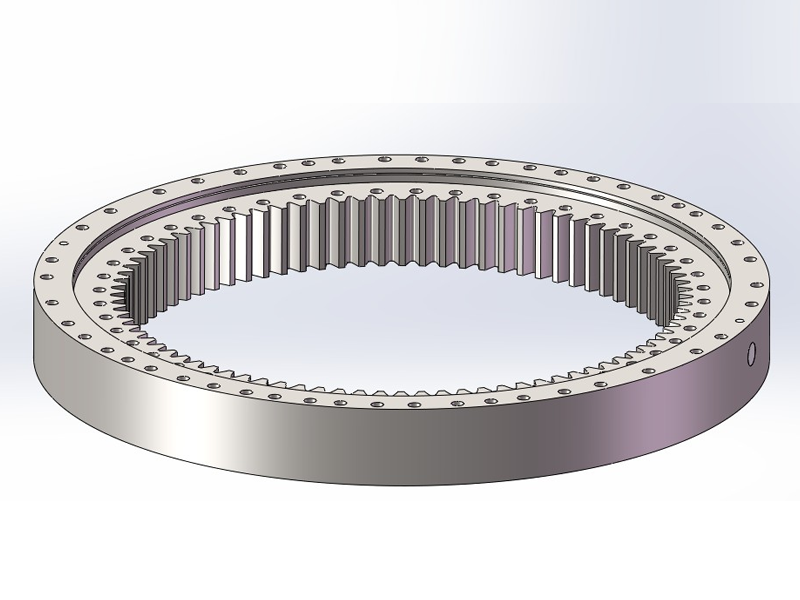
High-performance rotational components are defined by their ability to maintain structural integrity under severe mechanical stress. When designing parts for heavy earthmoving, engineers prioritize several distinct operational features to ensure maximum field reliability.
The most defining feature is extraordinary load-carrying capacity. For instance, reference models like the LQNA1815-45Z1 utilize advanced induction hardening processes on the raceways. This achieves specific depth and hardness levels, typically ranging between 55 and 60 HRC. This specialized metallurgical treatment allows the bearing to support massive vertical weight while simultaneously resisting the violent leverage forces generated by long booms.
In addition, these units offer a highly compact, space-saving design. In traditional mechanical engineering, supporting heavy rotating equipment often required a bulky kingpost design with separate radial and thrust bearings. A single slewing ring replaces this configuration entirely. By handling all load directions in one horizontal plane, it drastically reduces the vertical space and overall weight required in the machine's architecture.
Installation is also streamlined. Unlike standard bearings that require complex press-fitting, slewing rings feature integrated mounting holes. These through-holes or tapped holes are spaced precisely along both rings. Technicians can bolt the bearing directly to the upper and lower bases of the machinery using high-tensile fasteners, drastically cutting down assembly time.
The internal architecture determines load-carrying capacity, rotational friction, and overall suitability. Mechanical engineers must carefully evaluate the rolling elements and their arrangement to match the exact demands of the equipment.
Single-Row Four-Point Contact Ball Bearings: This configuration is highly versatile. The internal structure features a single row of steel balls that make contact with the raceway at four distinct points. It manages axial, radial, and moment loads simultaneously within a compact footprint. While cost-effective for light automation, it lacks the rigidity required for heavy construction machinery.
Double-Row Ball Slewing Rings: When machinery requires higher load capacity but must maintain low rotational friction, double-row designs are implemented. Utilizing two separate raceways, this design distributes mechanical stress across more rolling elements. It provides a significantly higher threshold for overturning moments, making it reliable for medium-sized earthmoving equipment.
Crossed Roller Slewing Bearings: Engineered with cylindrical rollers arranged in a 90-degree alternating pattern. Because the rollers provide line contact rather than point contact, they offer superior resistance to deformation. This type is selected for applications where precise positioning is critical, such as tunneling equipment and radar arrays.
Three-Row Cylindrical Roller Bearings: For maximum load-bearing capabilities, this is the undisputed industry standard. The design separates load paths entirely: upper and lower rows handle axial forces and tilting moments, while a dedicated middle row manages radial forces. This is the ultimate structural choice for 100-ton excavators, offering unparalleled safety margins under extreme dynamic stress.
Bearing Type | Primary Load Capacity | Rotational Precision | Ideal Application |
|---|---|---|---|
Single-Row Ball | Low to Medium | Standard | Small cranes, light automation |
Double-Row Ball | Medium to High | Standard | Medium excavators, material handling |
Crossed Roller | Medium | Extremely High | Precision robotics, tunneling machines |
Three-Row Roller | Extremely High | High | Heavy construction, 100-ton excavators |
The heavy equipment sector places the most severe demands on mechanical components. Parts must withstand continuous vibration, abrasive dust, and massive dynamic loads. Looking at recent industry trends, there is a clear shift toward predictive maintenance. As construction timelines tighten and equipment sizes scale up to meet ambitious infrastructure goals, the demand for ultra-reliable rotational components has surged. The integration of advanced metallurgy, IoT sensor monitoring, and automated lubrication is actively reshaping how these heavy-duty bearings are deployed on modern job sites.
In an excavator, the slewing ring is the sole mechanical component connecting the tracked lower chassis to the rotating upper house. During intense digging operations, the machine generates immense breakout forces. These translate into severe overturning moments. The bearing must absorb these violent shock loads without flinching. Without a properly specified, reinforced component, structural integrity is rapidly compromised, leading to catastrophic failure during high-torque digging cycles.
Cranes face similar extremes. They are fundamentally designed to lift massive payloads at significant distances from their center of gravity. In tower cranes, the bearing sits at the top of the mast. Absolute stability is non-negotiable; even a millimeter of internal clearance can translate to dangerous swaying at the end of the jib. Consequently, crane manufacturers rely heavily on high-rigidity three-row roller bearings to ensure maximum operator safety.
Concrete pump trucks and mining excavators also push these bearings to their limits. Long, articulated booms create significant leverage forces, coupled with rhythmic vibration. Bearings in these applications must be highly resistant to metal fatigue and feature robust sealing systems to survive abrasive, dust-heavy environments.
Selecting the correct bearing is a complex engineering decision. It directly impacts the lifespan, safety, and operational cost of heavy machinery. Procurement managers and engineers must evaluate multiple technical parameters systematically rather than relying solely on dimensional fit.
Step 1: Calculate Load Combinations
The fundamental step is accurately mapping the load profile. A thorough Finite Element Analysis (FEA) models how specific forces interact with the raceways under maximum stress. You must calculate the Axial Load (vertical weight), Radial Load (horizontal forces like wind or lateral impacts), and the Tilting Moment (leverage force from suspended payloads). The tilting moment is consistently the most critical force to evaluate.
Step 2: Determine Gear Requirements
The configuration of the gear teeth depends entirely on spatial constraints. Internal gears are predominantly used in excavators because the design encloses the gear mechanism within the machine's housing, protecting it from flying rocks. External gears are standard for tower cranes, allowing for easier visual inspection of the gear mesh.
Step 3: Assess Environmental Conditions
Job sites are unforgiving. Exposure to temperature fluctuations, heavy rain, and abrasive mud dictates the necessary sealing technology. When sourcing a reliable Slewing Ring for Construction, ensuring the presence of heavy-duty, debris-resistant multi-lip seals (like NBR or Viton) and specialized anti-corrosive coatings is a mandatory procurement specification.
Step 4: Rotational Speed and Duty Cycle
Construction equipment typically operates at very low rotational speeds—often less than 5 RPM—but under exceptionally high torque. A high duty cycle requires a bearing with superior fatigue resistance and optimized raceway hardening depth to prevent subsurface material flaking.
Even the most precisely engineered component will fail prematurely if subjected to improper maintenance. Establishing strict maintenance protocols is essential for minimizing costly equipment downtime.
Lubrication is the absolute lifeblood of the bearing. Grease serves a dual purpose: it significantly reduces metal-to-metal friction and acts as a secondary physical barrier against moisture. For instance, maintaining a massive 100-ton Excavator Slewing Ring requires strict adherence to schedules using high-quality, Extreme Pressure (EP) lithium-based grease. During routine checks, technicians should look for grease purging at the seals to ensure contaminated grease is pushed out. Modern heavy machinery increasingly integrates automated centralized lubrication systems to eliminate human error.
Over time, immense localized stress can lead to specific mechanical failures. Continuous high-impact loads cause micro-cracks beneath the raceway surface, eventually leading to flaking or "spalling." Inadequate lubrication accelerates wear on the gear teeth, increasing backlash and reducing precision. Seal degradation is another primary concern; once abrasive particles bypass the rubber seals, they act as a grinding compound that rapidly destroys internal components.
While modular vee guide wheel systems exist for clean, high-speed environments, traditional enclosed slewing rings remain irreplaceable in heavy construction. Their unmatched load density and unique ability to handle massive overturning moments ensure they will remain the undisputed standard for excavators and heavy cranes.
Slewing rings are the unsung heroes of modern heavy machinery. They provide the foundational strength required to navigate the grueling demands of active job sites. Choosing the correct bearing type directly dictates the success, safety, and longevity of your equipment. Careful selection and rigorous load calculations prevent costly downtime and mitigate severe safety risks. We highly encourage procurement managers and engineers to consult with industry experts and review specific load requirements before making a purchase. By investing in quality parts and adhering to strict maintenance protocols, you can significantly extend the lifespan of your machinery. We recommend exploring the highly durable Slewing Ring for Construction from Masfy to meet the exact specifications of your most demanding, heavy-duty projects.
Premature failure is almost always linked to three main culprits: inadequate lubrication, consistent overloading beyond the designed tilting moment, and poor installation. If the mounting structure is uneven or the bolts are improperly torqued, it distorts the bearing ring, creating concentrated stress points that rapidly destroy the raceway.
Key indicators of a failing bearing include excessive play or rocking in the upper structure of the machine, unusual grinding or popping noises during rotation, and increased resistance or shuddering. Additionally, if routine maintenance reveals large metallic flakes (spalling) in the purged grease, internal structural failure has already begun, and replacement is imminent.
The operational lifespan is heavily dependent on the machinery's duty cycle and operating environment. Under normal heavy construction conditions with proper, consistent lubrication, a high-quality bearing typically ranges from 10,000 to 15,000 operating hours. Exposure to extreme shock loads or failure to maintain seal integrity can reduce this lifespan drastically.
Yes, remanufacturing is a highly viable and cost-effective option for large-diameter bearings. If removed from service before catastrophic failure occurs, specialized facilities can grind the raceways to a slightly larger dimension, install oversized rolling elements, and replace the seals. This precision refurbishment process restores the bearing to OEM specifications, often saving up to 50% compared to purchasing a brand-new unit.
The primary difference lies in the specific location of the machined gear teeth. External gears feature teeth cut onto the outer diameter, which is common in tower cranes because it allows for easy access and visual inspection. Internal gears have teeth on the inner diameter, which is standard for earthmoving excavators. Internal gears utilize the machine's external housing for protection, shielding the gear mesh from harsh environmental debris.

 +86-13955534080


